THE INVEST HAVEN
The Rules Are Changing Mid-Game
Wednesday’s FOMC meeting is almost certainly Jerome Powell’s last as chair. His replacement told the Senate he plans to abolish forward guidance, kill the dot plot, and rewrite the inflation framework. The market spent 15 years learning to read the Fed. That language is about to be discontinued.
 
From Our Partners
Editor’s Note: What you’re about to read involves a specific provision of federal law that most financial advisors have never mentioned to their clients.
From the desk of Shanon Davis, CEO — American Alternative Assets
If you hold retirement savings in dollar-denominated accounts, what I’m about to show you could be the most important thing you read this year.
Most people don’t know that U.S. Code Title 31, Section 5117 gives the President legal authority to revalue America’s gold reserves by executive order alone. No congressional vote. No public debate. One signature.
FDR used this exact authority in 1934 — resetting gold from $20.67 to $35 overnight. No warning. Billions in wealth transferred before most Americans knew what happened. The investors already in gold protected everything. Everyone else watched.
Here’s what’s sitting on the books right now: the U.S. holds 8,133 metric tons of gold valued at $42.22 per ounce — a price set in 1973. At today’s market price, that’s a $1.59 trillion gap between the government’s ledger and reality.
Think about that. Every retirement account in America is priced against a dollar that pretends gold is worth $42. When that fiction breaks, the adjustment won’t be gradual.
Trump has publicly questioned why America doesn’t “use” its gold. No executive order has been signed. But the legal authority is in place — and the conditions justifying it are mounting.
Here’s what it means for your retirement:
Your IRA: Accounts already holding physical gold would sit on the right side of the largest government accounting correction in history
Your 401(k): Most target-date funds hold zero hard assets — they’d miss this entirely, just like 1934
The tax-free move: Reposition part of your retirement into physical gold now — no penalties, no taxable event
The window: FDR gave zero warning — investors who weren’t positioned missed the entire move
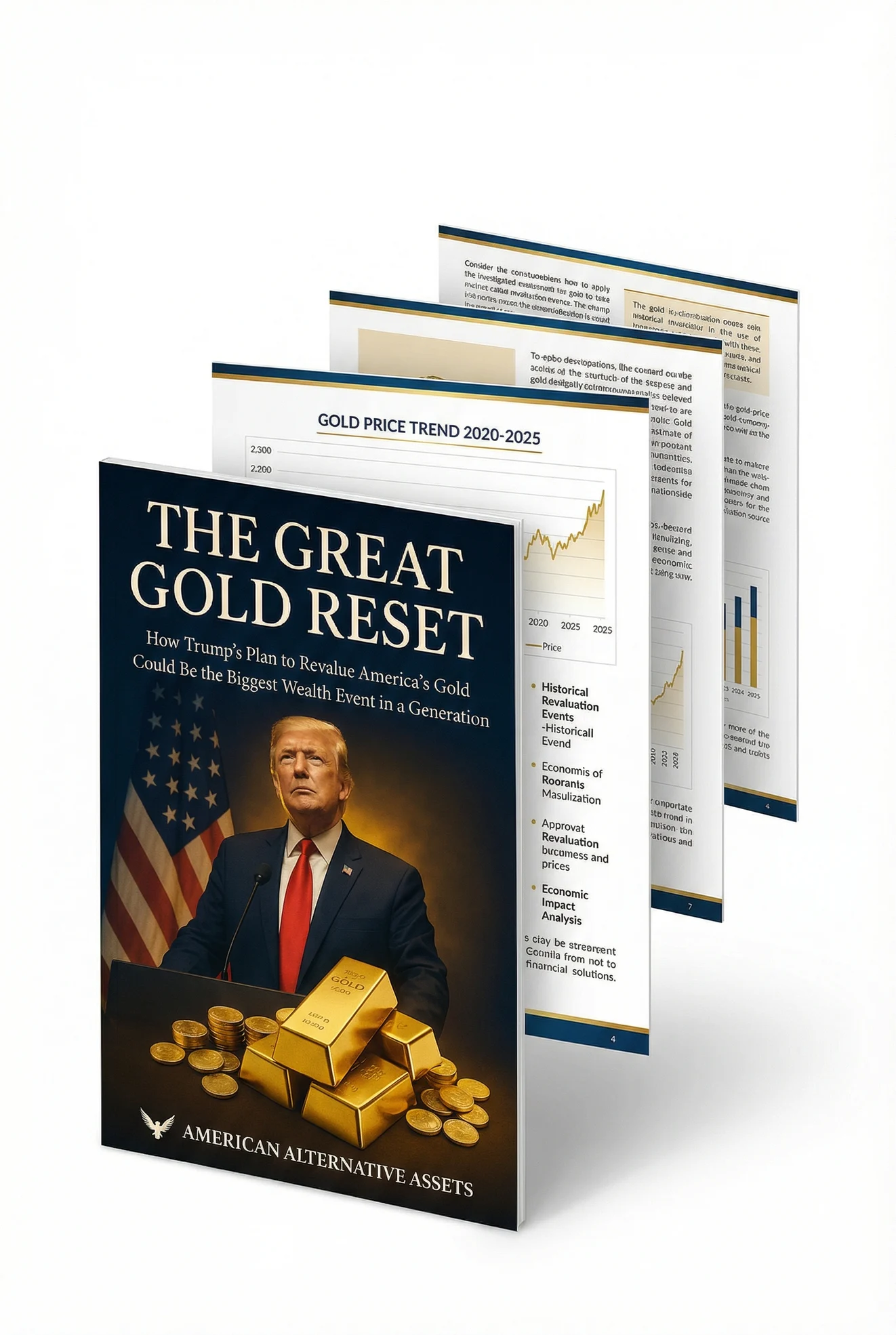
It’s called The Great Gold Reset — the kind of intelligence financial newsletters charge $97 to $297 for. Right now it’s yours free.
The Great Gold Reset Guide
— Shanon Davis
CEO, American Alternative Assets
P.S. If Title 31 is activated, the repositioning window closes before the announcement.
 
The Scoreboard
The chair: Powell’s term expires May 15. The DOJ dropped its criminal probe of Powell on Friday, clearing the path for Warsh’s Senate confirmation. Wednesday’s FOMC statement and press conference are the last under the current regime.
The successor: Warsh testified April 21 before the Senate Banking Committee. Called for “regime change in the conduct of policy.” Said Trump never asked him to commit to rate cuts. Told the committee the Fed has “a short window to bring inflation back down” — language economists read as hawkish.
The rate: Fed funds at 3.50–3.75%. Futures price a 100% probability rates are held Wednesday. CME FedWatch shows no more than one cut for all of 2026. JP Morgan forecasts the Fed could hike in early 2027.
The oil: Brent settled above $107 on Monday morning, WTI above $96. Iran offered a new proposal via Pakistan to reopen the Strait of Hormuz and end the war — but only if nuclear talks are deferred. Trump holds a Situation Room meeting on the offer today.
The market: S&P 500 closed Friday at 7,165, an all-time high. Nasdaq at 24,837. S&P is up over 9% in April; Nasdaq over 15%. Futures edged lower Monday morning on the stalled Iran talks and higher oil.
Details
The Fed you learned to read is being decommissioned.
Forward guidance. The dot plot. A press conference after every meeting. For 15 years, these three tools have been the system every portfolio model, every rate-sensitive trade, and every mortgage forecast in America depends on.

Kevin Warsh told the Senate Banking Committee on April 21 that he intends to dismantle all three.
What Warsh said under oath. He called the dot plot “a rough swag as to what was going on” with policy. He declined to commit to regular press conferences, saying “truth-seeking is more important than repetition.” He proposed a new inflation framework that moves away from core PCE entirely. And he advocated abandoning forward guidance, arguing that pre-committing to a rate path locks the Fed into decisions the economy has already outgrown. Four tools. Four planned demolitions. One hearing.

On Saturday this dispatch told subscribers the coming week would deliver a verdict on the gap between record markets and record-low consumer confidence. The Conference Board prints today; GDP, PCE, and four mega-cap earnings land Wednesday. That convergence thesis still holds — but the hearing transcript adds a dimension Saturday’s edition didn’t carry. The data doesn’t just test the current model. It may be the last data the market receives under the current model. The convergence week just acquired a variable nobody was pricing: the judge is changing.

The 1979 parallel. The last time the Fed changed chairs during an active energy crisis was August 1979, when Paul Volcker replaced G. William Miller. Oil had spiked following the Iranian Revolution. Inflation was running above 11%. Volcker walked in and hiked rates to 20% within eight months. Nobody at Miller’s final meeting predicted that. The incoming chair rewrote the rules the day he arrived. Warsh is not Volcker. But the structural parallel is genuine: a new chair arriving mid-oil-shock with a publicly stated intention to change how the institution operates. The difference is that Volcker inherited a Fed with no credibility crisis. Warsh, per the CFR’s analysis, arrives “with none of the gravitas that Greenspan had” and with the political baggage of a president who has publicly demanded rate cuts to 1%.

What this means for the screen on your desk. If Warsh eliminates the dot plot, the single most widely used tool for pricing the rate path disappears. Every fixed-income model that inputs dot-plot expectations will need to be rebuilt. If he abandons forward guidance, the market loses the signaling mechanism it has used since 2011 to pre-price rate moves weeks before they happen. That 6.5% mortgage rate you’ve been waiting to refinance doesn’t get recalculated by a more generous Fed. It gets recalculated by a less readable one.

The Iran variable Warsh can’t control. This morning, Axios reported that Iran offered the US a new proposal: reopen Hormuz, extend the ceasefire permanently, and defer nuclear talks. The catch is the point. Accepting the deal removes the bargaining position Trump needs for his primary war objective — stopping Iran’s nuclear program. Rejecting it keeps Brent above $100 and inflation elevated. Trump’s Situation Room meeting today decides which economy Warsh inherits. If the strait opens, oil drops, inflation eases, and Warsh walks into a softer environment with room to cut. If it stays closed, oil stays elevated, March’s 3.3% CPI print becomes the floor instead of the ceiling, and Warsh — who told the Senate he has a “short window to bring inflation back down” — may find himself raising rates, doing precisely the opposite of what the president who nominated him had in mind.
Wednesday is Powell’s farewell. May 15 is the expiration date. Everything between now and then is the last season of a system the market has been watching for 15 years. The replacement hasn’t told anyone what comes next.

Keep Reading